
Why did the robot do that?
A robot stops on your line. Finding out why pulls your best engineer off the roadmap — hours of triage, often a trip to site, while the line stays down. Torsen reconstructs the incident, pinpoints where it first went wrong, and hands support a case they can act on.
Every robot incident burns money in four places.
Not in missing data — you already log everything. In the human hours it takes to explain what happened.
$36k–$2.3M
per hour of downtime
FMCG to automotive · Siemens 2024
8h+
senior-engineer time per incident
pulled off the roadmap
$1.5k–$6k
per emergency site visit
when remote triage can’t answer it
$6.9M
service-ops loss, one RaaS vendor
in a single year · Symbotic FY2025
A 300-robot fleet leaks roughly $400k a year to this. Torsen is built to take back a third of it.
Same failure. Two ways to find out why.
A learned-policy humanoid lost its footing in a shared workcell and toppled toward an operator; the e-stop fired. Nobody was hurt. Scrub the raw log to find out why — then reconstruct it with Torsen.
Why did it fall toward the operator?
Freezes your clock, jumps to the failure window, surfaces the few signals that mattered.
Representative reconstruction, rendered — synthetic data, not a real customer incident. Built to show what a Torsen reconstruction looks like. The left clock is your own time, scrubbing right now. The right is a representative Torsen reconstruction time.
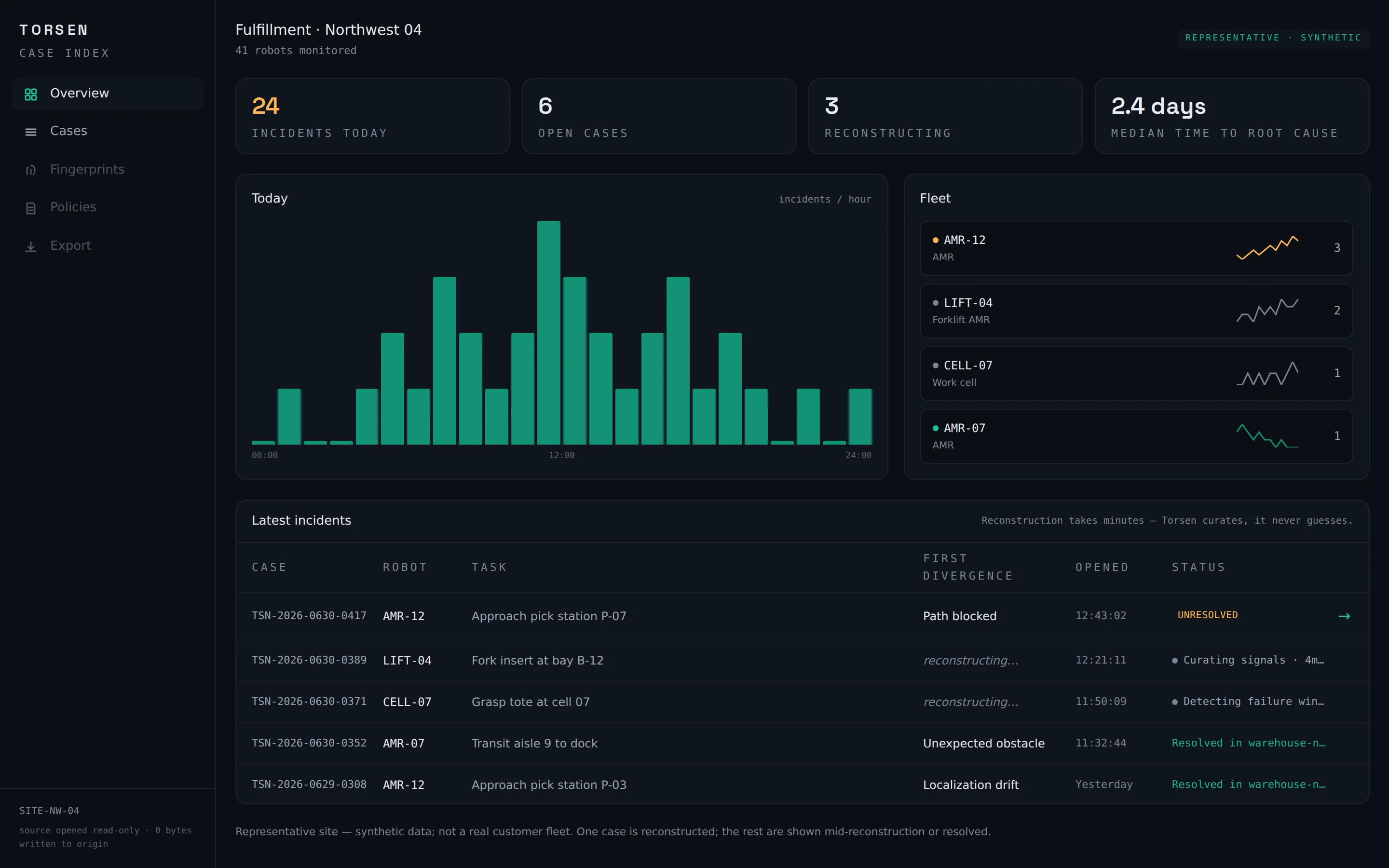
One reconstructed case. Not a log dump.
Torsen finds the failure window in a recording you already have, lines the run up against the runs that worked, and marks the first moment it left them. Support gets a case they can read, act on, and hand to anyone.
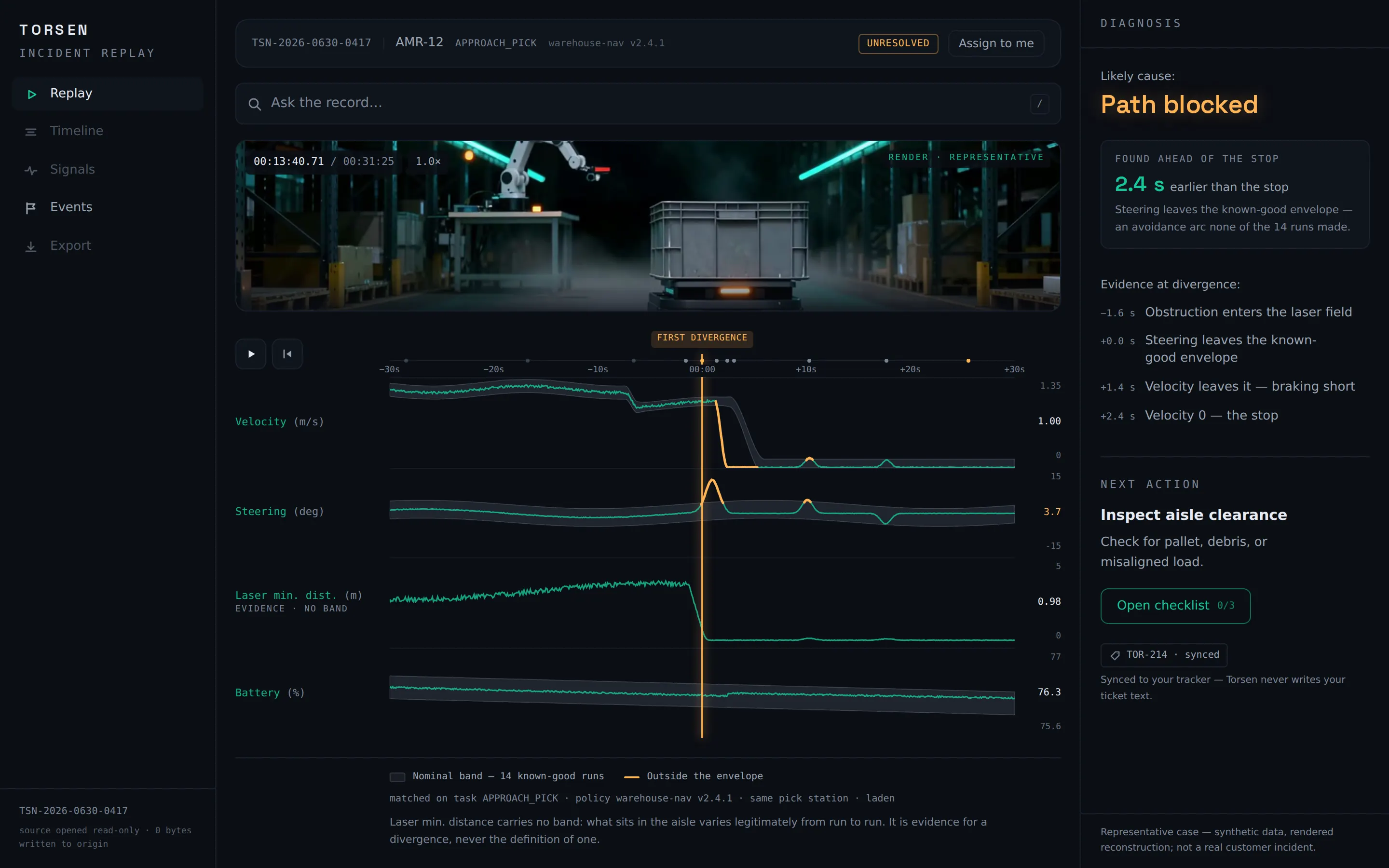
Compared against known-good
The same task, run normally, is the baseline — the band each signal should have stayed inside.
First divergence
The earliest moment the run left that band — found before the stop anyone would notice.
A shareable case
Diagnosis, evidence, and next action — one record support can act on and hand to anyone.
Keep your recorder. Torsen begins where capture ends.
Your stack already holds the recording, freezes the buffer when the fault fires, and assembles ROS, PLC and safety state into one view. None of that tells you which signals mattered, or where the run first left nominal. That part is still done by hand — by your most expensive engineer.
Your stack captures
rosbag2 · MCAP
The recording, already on disk.
Freeze-frame · rolling buffer
The fault doesn’t start the recording — it stops it.
SOVD · ros2_medkit
Faults, snapshots and PLC state, assembled and served over HTTP.
Foxglove · Rerun
Replay and visualization — once you know where to look.
Torsen investigates
Finds the failure window
In the recording you already have — no new instrumentation.
Compares against known-good
The same task, executed normally, is the baseline.
Marks the first divergence
And separates the cause from the cascade that followed.
Hands back a case
Evidence, next action — and what was never recorded.
Assembly is architecture. Interpretation is the work.
Read-only, start to finish — Torsen never writes to your bag, your robot, or your ticket.
You pay because it closes more cases with fewer experts.
Triage
Todayhours before a first useful hypothesis
Torsenthe case is already built when you open it
Expert escalations
Todayyour best engineer, pulled into every hard case
Torsensupport closes it from the record
Site trips
Today$1.5k–$6k when remote triage can’t answer
Torsenthe reconstruction answers remotely
Recurrence
Todaythe same failure comes back unnoticed
Torsena fix bound to a version, watched for regression
OEM example
144 incidents a year leak about $399k in senior hours, support, and trips. Cut that by 30% and Torsen returns roughly $120k a year — before churn or SLA credits.
Bring us your hardest unexplained failure.
We take a handful of incidents at a time. Tell us about a failure your logs couldn’t explain — one you already have a recording of — and we’ll follow up to reconstruct the grounded why with you, founder-to-engineer.
Not ready to bring a failure yet?